
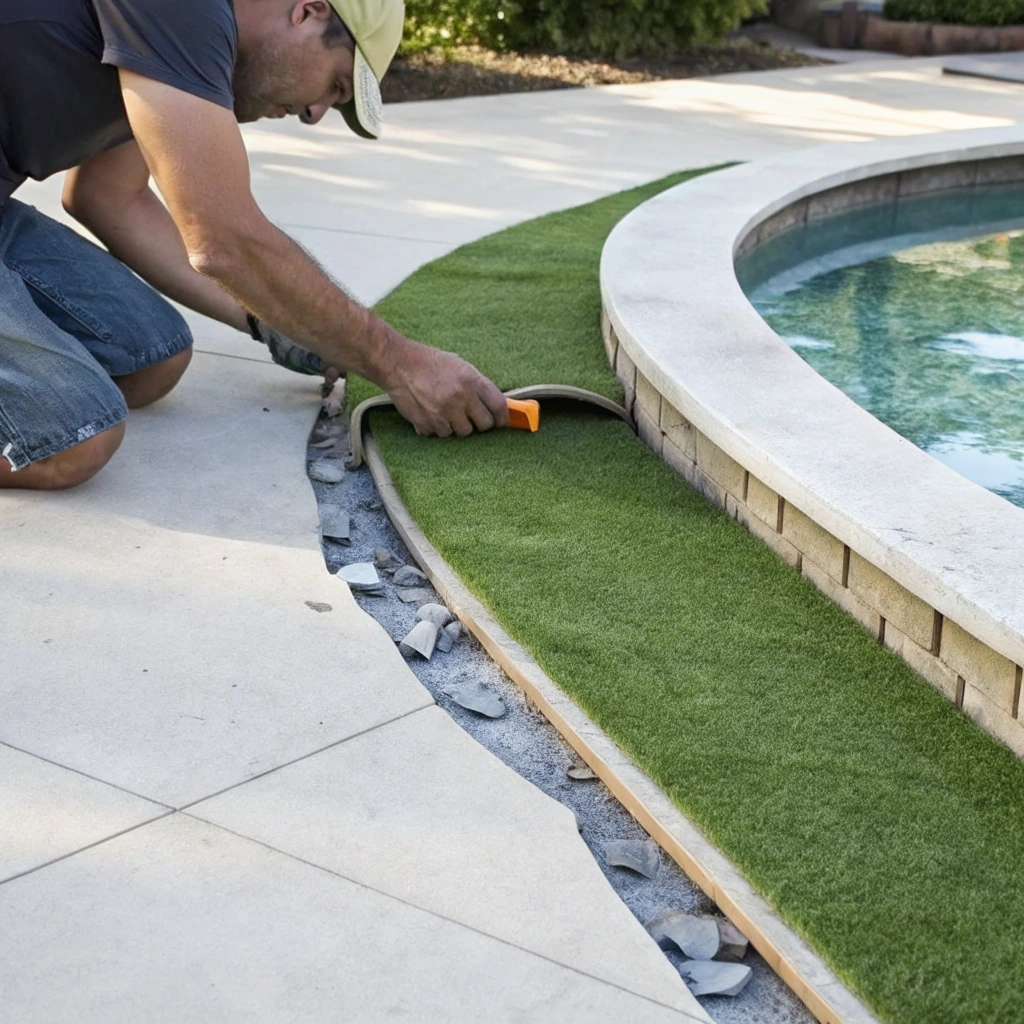
Synthetic Grass Repairs That Hold — What Separates a Professional Fix From a Patch Job
The difference between a repair that lasts and one that fails again within a season comes down to three things: correct diagnosis, correct materials, and correct execution. Skip any one of them and the repair becomes a patch — a visible, temporary cover that accelerates further failure around its edges.
A professional repair starts beneath the surface. Base condition is assessed before any adhesive is applied or any section is cut. If the sub-base has settled, compacted, or taken on moisture, fixing the turf above it without addressing what’s beneath produces a repair that moves, lifts, and opens again.
Material matching, adhesive selection, pile direction, seam placement, and join pressure are all technical decisions that determine whether the finished result is invisible or obvious. A patch job skips these steps. A professional repair treats each one as non-negotiable.
Every synthetic grass repair we carry out across Wollongong is built to outlast the problem that caused it — not just cover it over.

Common Synthetic Grass Repairs We Handle Across Wollongong
Lifting or peeling edges are among the most frequent problems we see across Wollongong properties — turf that has separated from its fixing along a fence line, boundary, or hard surface edge. Left unattended, the exposed edge curls, collects debris, and becomes a trip hazard. Open seam lines are similarly common, developing when two joined sections of turf begin to separate. Once a seam starts to open, the edges curl and fray quickly, and the join becomes increasingly visible and difficult to close cleanly. Localised damage from burns, cuts, tears, or pet digging creates a hole or visibly compromised section within the main body of the turf that affects the appearance of the entire surface.
Flat and compacted infill in high-traffic zones leaves the pile without resilience or height, producing a worn patch that stands out against the surrounding surface. Drainage failure — where water pools rather than dispersing through the surface — typically points to a blocked or compacted base beneath the turf rather than a product issue. Each of these problems is repairable by a qualified local technician without replacing the full installation.
Lifting and Peeling Edges — What Causes Them and How We Fix Them
Lifting edges happen when the original fixing along a boundary fails — through inadequate adhesive, ground movement, or root intrusion from adjacent garden beds. The repair involves lifting the affected section, cleaning and recompacting the base beneath, re-tensioning the turf, and re-fixing with appropriate adhesive or mechanical fixing to the boundary. Addressed early, the result is a flat, secure edge that holds long-term.
Open Seam Lines — Why They Worsen Fast and What the Repair Involves
A seam that starts separating will not stop on its own. As the edges lift and curl, debris collects beneath, the fraying accelerates, and the join becomes harder to close invisibly. Professional seam repair involves lifting both edges, cleaning the join area, recompacting the base if required, re-tensioning both sections, and bonding the seam with the correct jointing tape and adhesive to produce a clean, flat finish.
Localised Damage Repairs — Burns, Cuts, Tears, and Pet Digging
Isolated damage within the main body of the turf — from a hot coal, a sharp object, or a dog that found a spot to dig — is repaired through section replacement. The damaged area is cut out cleanly, the base beneath is prepared, and a matching replacement piece is fitted and joined. A well-executed section repair is invisible in the finished result.
Flat and Compacted Infill — Restoring Pile Height in High Traffic Areas
Infill displaces and compacts over time in areas that take the most foot traffic — pathways, play zones, and pet runs. When the infill drops below the pile fibres, the surface loses its resilience and the worn patch becomes visually obvious. Restoring pile height involves power brushing the compacted area and introducing fresh infill to bring the surface back to its original density and appearance.
Section Replacement — Matching, Cutting, and Joining Without a Visible Patch
The quality of a section replacement comes down to two things: product match and execution. Getting either wrong produces a repair that’s more visible than the original damage.
Product matching requires either a remnant from the original installation — the best outcome, which is why we always recommend clients store off-cuts when a new lawn is laid — or a careful assessment of the existing turf’s pile height, fibre colour, density, and texture to source the closest available match. Our familiarity with the products commonly installed across Wollongong and the Illawarra means we can identify and match most residential and commercial turf products accurately.
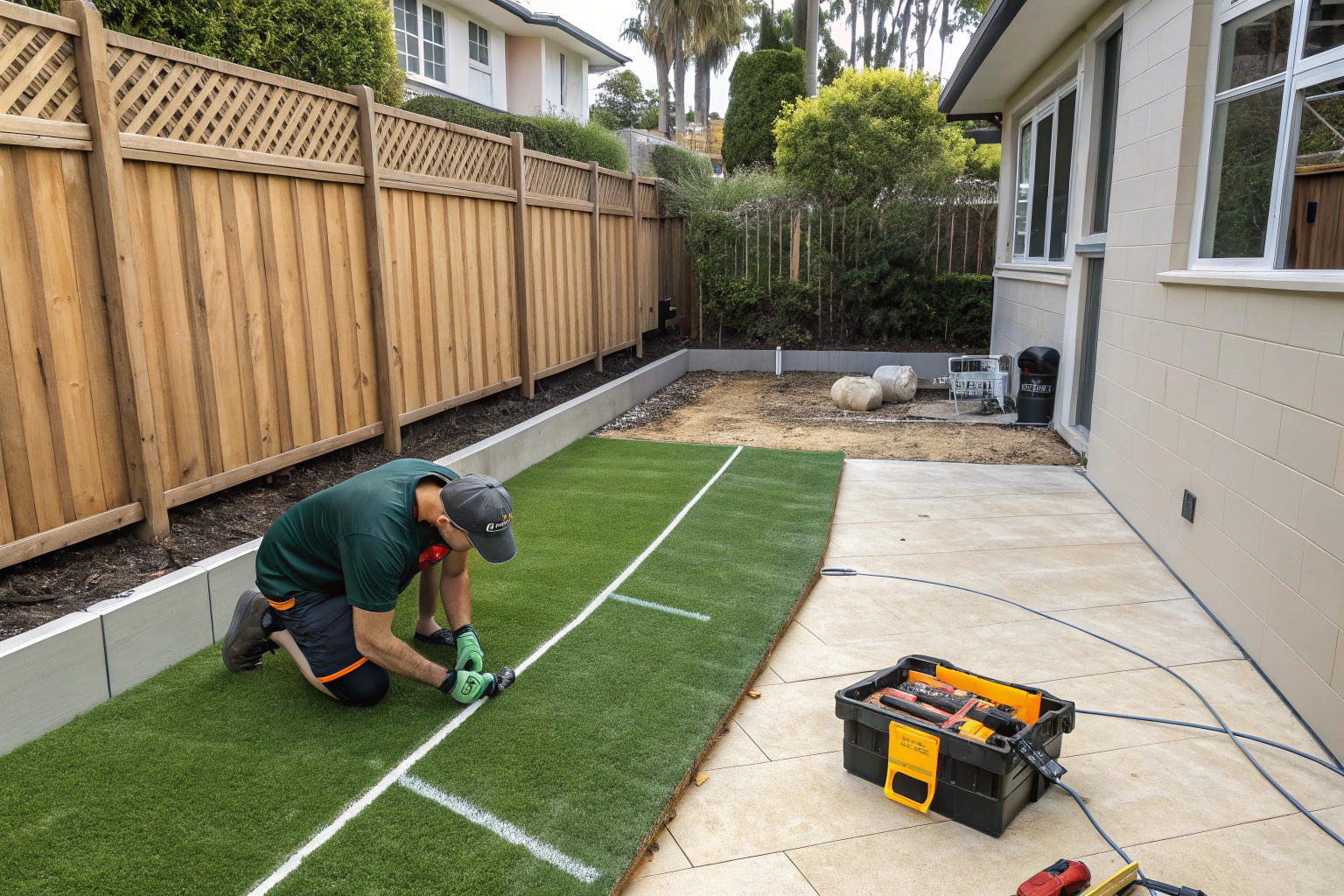
Once the correct product is sourced, the damaged section is cut out with clean, straight edges that follow the direction of the pile. The base beneath is inspected and prepared before the replacement piece is fitted, tensioned, and joined using the correct jointing tape and adhesive. Pile direction, seam placement, and join pressure are all critical to producing a finish that disappears into the surrounding surface. A professionally executed section replacement leaves no visible patch — just a restored, continuous surface.
How We Diagnose Synthetic Grass Problems Before We Repair Them
Not every synthetic grass problem is what it appears to be on the surface, and repairing the symptom without identifying the cause produces a repair that fails again. Before any work is recommended, we carry out a thorough assessment of the affected area and the conditions around it.
- A lifting edge may indicate a drainage problem beneath the turf rather than a fixing failure
- Pooling water on the surface often points to base settlement or compaction rather than a turf product issue
- A flat, worn patch may be fully recoverable through infill replenishment and power brushing rather than section replacement
- An open seam may reflect ground movement in the base beneath rather than adhesive failure at the join
Understanding what has actually caused the problem determines what the correct repair looks like. A seam re-bonded over an unsettled base will open again. An edge re-fixed over a drainage problem will lift again.
Our assessment process covers the turf surface, the fixing points, the base condition, and the drainage beneath — so the repair addresses the cause, not just the visible result. Wollongong property owners get a clear explanation of what went wrong and exactly what the repair will involve before any work begins.
Infill Replenishment — Bringing Back Resilience and Appearance
Infill is what gives synthetic grass its upright pile, its underfoot cushioning, and its ability to recover after foot traffic. Over time — particularly in high-use zones like kids’ play areas, pet runs, and entertaining spaces — infill displaces, compacts, and depletes. The pile fibres lose their support, the surface flattens, and the turf starts to feel and look worn even when the fibres themselves are in good condition.
Infill replenishment is one of the most cost-effective repairs available for an ageing or high-traffic synthetic grass surface. The process involves power brushing the affected area to loosen compacted material and lift the pile fibres, followed by the introduction of fresh infill worked evenly into the surface to restore the correct depth and density. The right infill type matters — silica sand, crumb rubber, and organic infill products each perform differently, and the replenishment material needs to match what’s already in the installation. A correctly replenished surface recovers its original resilience, appearance, and drainage performance without any section replacement required.
Periodic Inspection — Catching Small Problems Before They Become Expensive
Synthetic grass is low maintenance — but it is not zero maintenance. The conditions across the Illawarra work on installations over time, and small problems that are straightforward to address early become significantly more involved once they develop.
An edge that has begun to lift by a centimetre is a ten-minute fix. Left through a Wollongong winter of rain and ground movement, that same edge can pull back far enough to expose the base, collect root intrusion from an adjacent garden bed, and require a full edge re-fix with base remediation beneath. A seam showing the first signs of separation can be re-bonded cleanly. A seam that has been open for months requires more extensive re-tensioning and base work to close properly.
A periodic professional inspection covers edge fixing points, seam integrity, infill levels, pile condition, and sub-surface drainage — the full picture of how an installation is performing. Catching a minor issue at inspection keeps the repair simple, fast, and affordable. It also extends the serviceable life of the full installation across suburban Wollongong properties significantly.
Synthetic Grass Repair vs Full Replacement — How We Help You Decide
| Repair is the right call when… | Replacement makes more sense when… |
|---|---|
| The damage is localised — a single lifted edge, an open seam, or an isolated section — and the surrounding turf is in good condition. A targeted repair restores the surface without disturbing what’s working. A professional assessment will confirm whether the base beneath is sound and the repair will hold long-term. | The turf has reached the end of its serviceable life across the full installation — fibres are brittle, faded, or flattened beyond recovery through infill replenishment or section work. Where multiple failure points exist simultaneously across the surface, full replacement delivers better long-term value than repeated repair. |
Frequently Asked Questions
Yes. Lifting edges are one of the most common repairs we handle. The affected section is re-tensioned and re-fixed to the boundary without disturbing the surrounding turf or requiring any product replacement.
If the damage is localised — a lifted edge, open seam, or isolated section — repair is almost always the right call. Full replacement becomes relevant only when the entire installation has reached the end of its serviceable life.
The most common causes are inadequate original fixing, ground movement in clay-heavy soils, and root intrusion from adjacent garden beds. Coastal salt air can also corrode metal fixing components over time, accelerating edge separation.
Yes, provided the replacement piece is correctly matched to the existing product. Pile height, fibre colour, density, and texture all need to align. A well-executed section replacement leaves no visible patch.
Pooling typically indicates a blocked or compacted base beneath the turf rather than a product failure. A professional assessment will identify whether the issue is sub-surface drainage, base settlement, or a combination of both.
Most standard repairs — edge re-fixing, seam re-bonding, or infill replenishment — are completed within a few hours. Section replacements involving product sourcing may require a follow-up visit once the matching material is confirmed.
Get a Free Synthetic Grass Repair Assessment Across Wollongong
A damaged or failing synthetic grass surface doesn’t have to mean a full replacement. Most problems — lifting edges, open seams, compacted infill, localised damage, drainage issues — are repairable by an experienced local technician at a fraction of the cost of starting again.
We service residential and commercial properties across Wollongong and the broader Illawarra, from Thirroul and Corrimal through to Shellharbour, Dapto, and Kiama. Our assessment process covers the full picture — turf surface, fixing points, base condition, and sub-surface drainage — so the repair addresses the cause, not just what’s visible.
Get in touch today for a free repair assessment and quote. Fast response, local expertise, and a repair approach that holds long-term.
